Tuesday, 15 February 2011

End of module evaluation


BA (Hons.) GRAPHIC DESIGN
LEVEL
04
 Module Code 
OUGD102               


 Module Title
DESIGN PROCESS


END OF MODULE SELF-EVALUATION

NAME
Sadie Thompson
BLOG. ADDRESS
http://s-thompson1013.blogspot.com/

1.  What skills have you developed through this module and how effectively do you think you have applied them?

The main skills I have built on are my Illustrator skills due to the Collection 100 brief, especially when tracing the 100 sex positions, which through repetition has helped me to vector very quickly. Also I have had to think quickly when changing subject quite a way into the brief. I had to make a judgement whether it was best to start from scratch or carry on with a subject I saw going nowhere. Choosing to start over I feel is a decision that has paid off in the end.

2. What approaches to/methods of research have you developed and how have they informed your design development process?

My methods of research have improved greatly throughout this brief, I have been encouraged to consider many different types of researching which I have never thought of before. Such methods include primary, secondary, qualitative and quantitative research. I have particularly found my primary research very useful, as it is my potential audience and target markets opinion that counts towards my finished products.

3. What strengths can you identify in your work and how have/will you capitalise on these?

I think the main qualities within this module’s work are my ideas and development on these. I think that in both the What if… and Collection 100 briefs the ideas are solid, original and have potential to be successful in today’s market. Especially in the Collection 100 brief I have been able to come up with a solid idea and develop it through my research and also respond to feedback in my crits to improve the final outcome.

4. What weaknesses can you identify in your work and how will you address these more fully?

I feel that my final designs in the Collection 100 brief could have been improved. For example I would have made the packaging slightly bigger to accommodate the contents without damaging it. I also found it quite an obstacle to find a way to package an egg shape that both looks good, is cost effective and is easy to make within the facilities and equipment that I personally have access to.
Also in the What if… brief I feel I made great input when considering the research and development side of things, but I feel I could have contributed more to the final designs, but found it hard to do this as a group.


5. Identify five things that you will do differently next time and what do you expect to gain from doing these?

*Work better within a group and try to get everyone to contribute equally in all aspects of the brief. Being able to work well within a team is a valuable asset to have, but something I maybe need to work on.
*Use more questionnaires and surveys within my research, this would help me to organise my findings and also be able to respond to accurate statistics and numbers, rather than random opinions.
*Organise my time more efficiently. Although I do feel this has improved since the last module it is something I could work on more to respond to the briefs set to my full potential, not just until my time runs out.
*Blog as I go. This is another thing I feel that has been improved since the last module, but I have still found that I had to fill in a lot of missing blog posts when the deadline came closer. Instead of blogging straight away I have been saving the information to post later, which is something I need to get out of the habit of doing. This is not only to save time and stress at the end of the module, but to keep my blog posts accurate and fresh.
*Use more design sheets. This module it seems that I have leapt straight from research to designing on the computer, without many mock-ups. This has meant that I have had to re-do a lot of my designs, rather than developing them to their full potential in the first place.

6.How would you grade yourself on the following areas:
(please indicate using an ‘x’) 

5= excellent, 4 = very good, 3 = good, 2 = average, 1 = poor

1
2
3
4
5
Attendance


X

Punctuality


X


Motivation


X

Commitment


X

Quantity of work produced


X


Quality of work produced


X

Contribution to the group


X

The evaluation of your work is an important part of the assessment criteria and represents a percentage of the overall grade. It is essential that you give yourself enough time to complete your written evaluation fully and with appropriate depth and level of self-reflection. If you have any questions relating to the self evaluation process speak to a member of staff as soon as possible.

Monday, 14 February 2011

Visual Language... Book Works

The Brief
Create an edition of 10 hotdog fold books with the theme 'squares'

Considerations
Layout- open like a book or a leaflet? Think of pop-ups, pouches, inserts, repeat patterns and posters.

Target Audience
Book fair goers, mainly art students.

Tone of Voice
Aesthetically pleasing. Funny? Quirky?
Something that is visually appealing, considering a poster... having a second use from being a book.

Background
Initially looked at squares of food. Repeatable patterns? Thinking illustration of things 'square' on poster side, on book side the image enlarged and pixelated, leaving just coloured squares.

Mandatory Requirements
Broad range of visual investigation. Ten books that are a series or a set.

Deliverables
Edition of ten hotdog fold books.

Studio Deadline
Tuesday 1st March.

Collection 100...

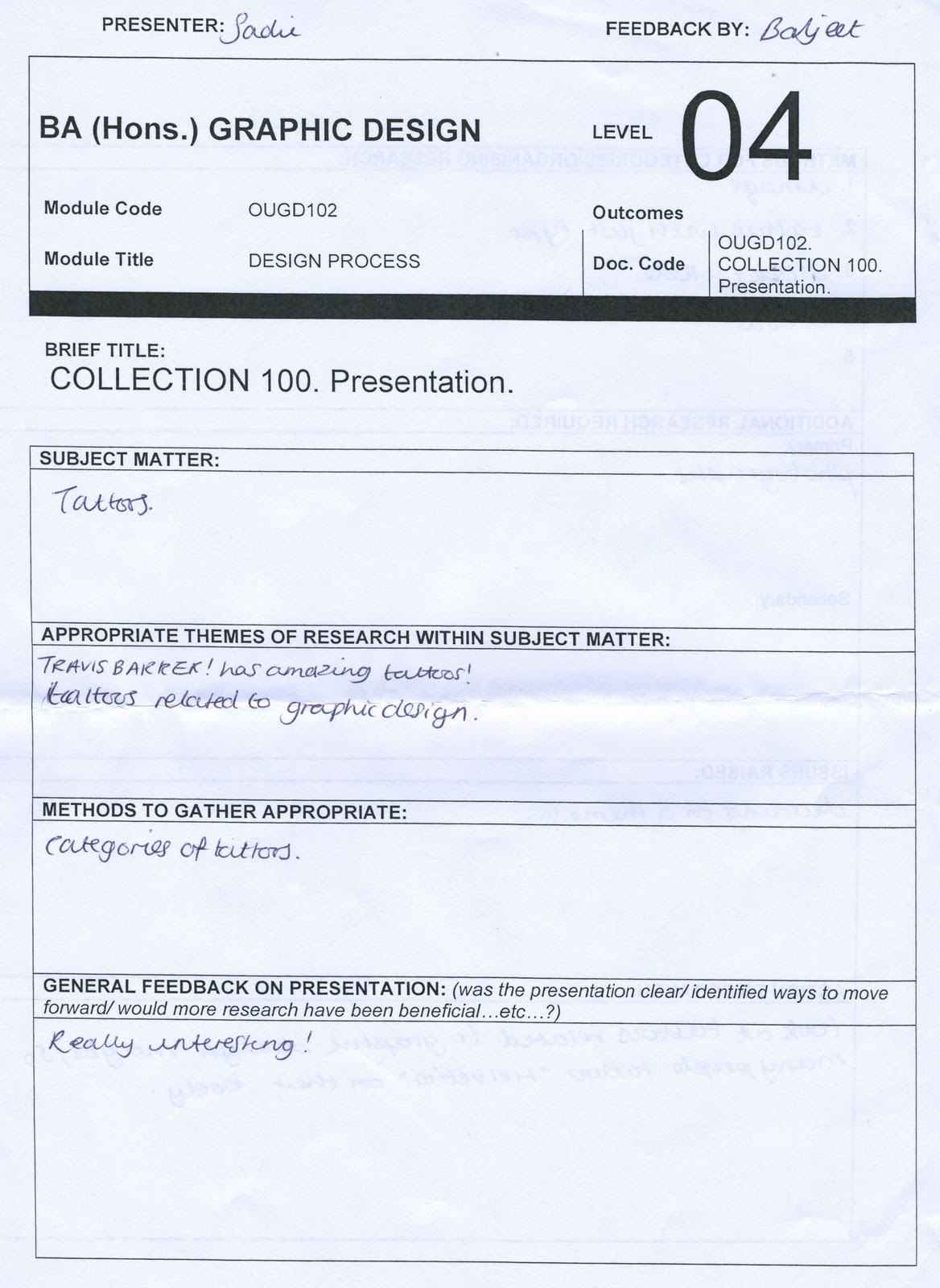
Feedback from 2 minute presentation

Change of topic!
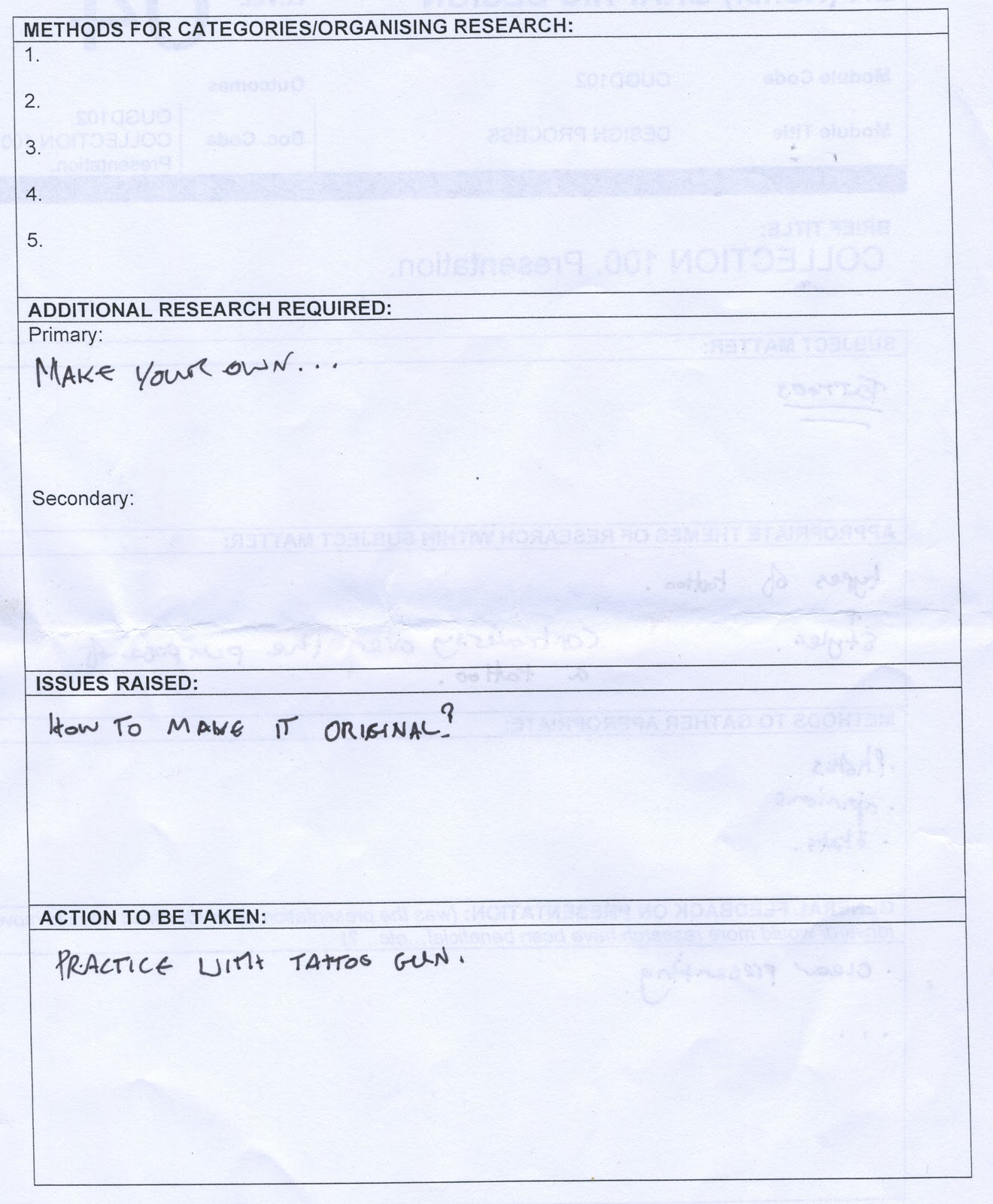
After doing all of my initial research unfortunately my tattoo gun broke, which left me with no more ideas and at a bit of a dead end. I decided to change my topic to 'sweets' and start from the beginning.


Progress crit
I was told that my idea to design and produce 'Love Eggs' which would contain a condom and a different sex position was a good one and is something that is current and marketable. Although the idea was good, I had to rethink my design paying attention to the appropriate font used and layout, and watching out for widowing with the text. Also I originally used the same colour scheme throughout the 100 designs, I was told to add a bit of a mix with this to give it more variation. The way I decided to resolve this is by using the classic traffic light colour code to depict whether a position is rated as easy medium or hard, to not only keep the designs looking interesting but to also give the colour variations some relevance.


Feedback from students
Issues raised:
Size of plastic packaging potentially damage product.
Image works but colour and typeface?
Action to be taken:
Larger packaging- try bright pink (look at Anne Summers for colour examples) not keen on heavy orange.
Add cigarette to package.
Blue one= group.
Put a Unipol mint into packaging.
Other accessories? Cock ring?


Self Evaluation
I am extremely pleased with my concept and have had a lot of positive feedback from other students, which could be a potential audience to aim at. I think that it actually has potential to sell, to the extent that I am considering emailing places like Anne Summers with my idea. I like the idea of using colours to indicate the level of difficulty and effort involved with the position, especially on the packaging so that the consumer has the power to choose beforehand without taking away the element of surprise when getting the random sex position. I do think however that I need to make it clearer what the colours are indicating which proved a problem in the crit which involved other students. If I had more time I would resolve this by making a point of sale that would present the eggs in a shop, promoting the product and clearly indicating what the colour coding means. 


Final Pieces:


Monday, 20 December 2010

What if...

Brief: Create three design direction boards showing research based on our rationale.
1. Problem 2. Evidence 3. We Intend To...

Rationale
Group Members - Claudia, Chloe, Liv, Ryan, Sadie & SimonProblem - What secrets and  surprises can you find in Leeds?Evidence - Our variation of photographs of Leeds as a group and our personal experiences, along with the opinions of others found in our research.We Intend To - Discover the secret surprises of Leeds and find a way to communicate them to the appropriate audience.

Primary and Secondary Research
Primary Qualitative: Pictures of St George's field, our opinion was that it was quiet and secluded. We asked a resident and they said that they liked going to St George's because it is quiet and not full of students. As a group we decided that there is a lack of non-student places to go in Leeds.
Secondary Qualitative: 'Bakelady's homemade tearoom'. Bakelady doesn't reveal her address until days before the booking to keep it secret. She referred to it as the 'underground tearoom' and a magazine article has said that it is exceptional value with excellent homemade food and is a completely different way to spend your afternoon.
Primary Quantitative: We created a 'Secret Leeds' Facebook group- out of 20 members 3 replied, although this didn't help us to find more places it supported our thought that not many people know the hidden secrets of Leeds.
Secondary Quantitative: 4 out of 5 leaflets and magazines we looked at were aimed mainly at students.

Progress Crit
Generally our ideas of a secret tea party in Leeds was well liked by the group and they could all see it working well as a live brief. Also after researching 'secret Leeds' we found a similar project to do with London, which has been executed and worked well in the real world. The main point that was brought up in our crit was that if our idea was to be executed well the branding had to be appropriate, but most of all consistent. 
Direction boards presented in crit:

Research
Evidence 
 What we did

Final pieces:

Map 

Poster

 Picnic

Going live

Self Evaluation

What problem did you identify? 
That there is a lack of places to go in Leeds to escape the student life. Because Leeds is buzzing with students all the places to go seem to be aimed directly at students, leaving nowhere for the residents or even students that don't have the typical stereotypical lifestyle. In the hustle bustle of busy Leeds it is hard to find somewhere quiet and secluded to escape to.

What evidence did you find to support your decisions?
We made a Facebook group, showing the lack of knowledge of quiet places to go in Leeds, also we gathered all flyers, leaflets and posters that were available to us, the majority of them advertising cheap student nights out. This evidence backed up our idea, showing that there is  a gap in the market for what we intend to do.

What methods did you use to gather your evidence and what forms did it take? 
we used a variation of quantitative, qualitative, primary and secondary research. These included setting up a Facebook group, questioning our classmates and residents of Leeds, our own opinions, gathering leaflets and researching websites to delve further into the 'Bakelady's' concept of a hidden tearoom.

What methods of research did you find useful and why?
I think both the Facebook group and questioning people who actually live in Leeds proved very useful because they're our potential audience that will be using the 'Picnic in a Park' service.

5 things that I have learnt about the design process.
  • To back up your ideas with solid research, because your opinions on a topic isn't always necessarily the right one to go with.
  • To put yourself in somebody else's shoes to think what your potential target might respond to.
  • That working in a group is hard! Value other peoples deigns and embrace the fact that their is a varied amount of opinions and design styles.
  • Don't go with your first idea, even if it seems brilliant. Elaborate on it and test it out before going live.
  • Dont stick to one form of research, their are loads of ways to get information, the more varied the more informed you are and the more solid it makes your idea. 
5 things I would do differently next time.
  • Do more work in the first week to allow for more time to put or idea out into the public.
  • Organise more time to work as a group, and not only discuss our ideas but to design together.
  • Make sure all members of the group contributed equally, not only to the final designs but to the initial research and development process.
  • Make an action plan to organise ourselves as a group and to make sure that its a team effort.
  • Think of better ways to make this a live brief and record the reactions of the public to find if our idea would really work practically.
Group Evaluation

Monday, 22 November 2010

End of Module Self Evaluation


BA (Hons.) GRAPHIC DESIGN    LEVEL  04     Module Code      OUGD101             Module Title    DESIGN PRINCIPLES       
           END OF MODULE SELF-EVALUATION

NAME
 
   Sadie Thompson    BLOG. ADDRESS    http://s-thompson1013.blogspot.com/

1.  What skills have you developed through this module and how effectively do you think you have applied them?    
My time management and punctuality have both improved greatly since beginning this year, which has been something that was a problem in the past. I think that this also reflects my level of commitment towards the course .
I feel that I have learnt how to take criticism on board and channel it constructively to improve and develop my work. I also feel like I respond better under pressure and can produce an acceptable piece of design in a short time span.
Something that I am very pleased with is how quickly and easily I have found it to grasp the basics of Illustrator and Photoshop, especially knowing nothing at all about this software from the start.

2. What approaches to/methods of research have you developed and how have they informed your design development process?                    
 The main development for me has been recording the majority of the research that I do straight on to my blog. This particularly helps when referencing certain designers, artists, books or websites. I have also started to read more and find research from books rather than relying solely on the internet and search engines to do my research for me.
                 
3. What strengths can you identify in your work and how have/will you capitalise on these?               I am good at recognising faults within my work and improving them to develop and improve my work. I feel I am good at coming up with ideas on the spot and developing a concept so that it is relevant to the brief.
I enjoy making things aesthetically pleasing and colourful, although this doesn’t always apply to the brief I may be working on.

4. What weaknesses can you identify in your work and how will you address these more fully?          My main downfall is that my computer and software skills aren’t up to scratch, which I feel if they were it would help to aid my designs and in most cases give them a more professional finish.
When working with typography I find it hard to find type that works and is relevant to different aspects of the design. Image, concept and the space surrounding it being a few elements that need to be considered, although I am not entirely sure how.

5. Identify five things that you will do differently next time and what do you expect to gain from doing these?                   
Research more.
I feel I need to research in more depth before diving into an idea and getting too carried away with a concept. Another thing is recording all of my research as I go, as a lot of it does get lost due to lack of organisation.
Ask people’s opinions.
Develop my work by asking other people’s opinions and getting outside influences.
Blog as I go. I need record things on my blog as I do them as opposed to leaving it until the end of the week or brief deadline. By doing this it will ensure that I am recording my thought process while it is still fresh in my mind, and also avoid missing certain ideas or research out by mistake.
Experiment.
I need to explore and use different methods and techniques of working to broaden my skills and knowledge, even if I feel it is outside of my comfort zone. An example of this would be to explore different ways of printing within my work and experiment with different stocks.
Read.
Buy and read more magazines and newspapers on a regular basis to become more aware of contemporary designers, and also to respond to cultural influences.


No News is Good News... Mail Shot Feed Back